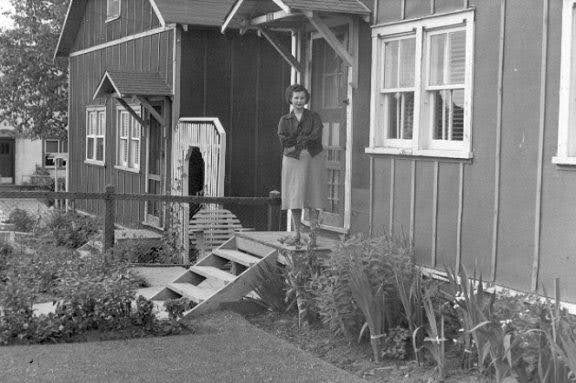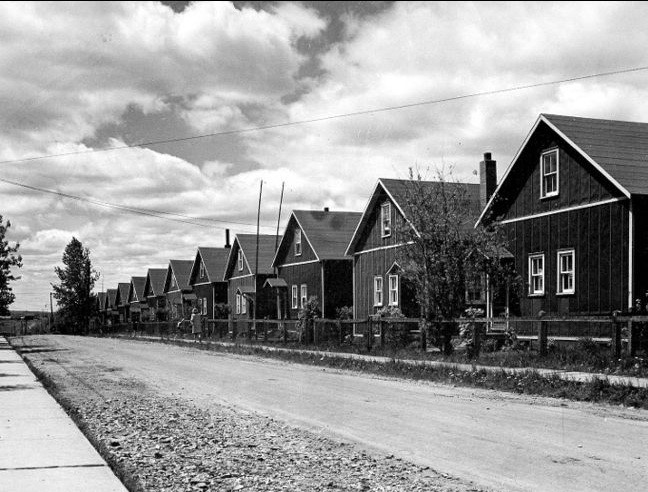
The mines were booming after the discovery of gold in the Porcupine Camps. So many people flooded the area looking for work that the mines had to come up with a plan for housing. In 1919, Hill, Clark & Francis of New Liskeard received a contract from the Hollinger Mine to build one-and-a-half-storey boxed homes. The homes started with four rooms: a living room, three bedrooms, and a small kitchen, with a toilet located outside. They were built close together on nine-metre lots with tarpaper siding, alternating between red and green.
Employees were charged $10.00 per month for a four-bedroom home, $12.50 for five bedrooms, and $15.00 for six bedrooms. The homes became known as the “Hollinger Houses,” and by 1921, 150 of these homes had been built. In the summer of 1936, pitched roofs were added to provide extra rooms.
Annual gardening contests were held, where residents planted flowers and vegetables on their tiny lots. Streets were named after First World War sites, including Vimy, Cambrai, Messines, and Borden, as a commemoration of the war effort. The homes became iconic in many people’s memories of living in Timmins.
“The Hill,” or “Hill District,” is a grid of half a dozen streets laid out with numbered avenues running east-west. Running north-south were streets named after trees: Spruce, Pine, Cedar, Balsam, and Birch. This helped establish a sort of “open” company town with room to grow.
Come visit our Hollinger House at the museum. Tour inside and see what life was like in the 1930s.
The Timmins Museum: National Exhibition Centre proudly dedicates the Hollinger House, located at 325 Second Ave., Timmins, ON, in honour of Diane Armstrong and Norah Lake.
A respected author, advocate, and historian, Diane’s enduring contributions to heritage preservation have left a lasting legacy and continue to shape our community today. This dedication recognizes her passion for local history and her commitment to sharing Timmins’ stories with future generations.
A founding volunteer and tireless champion of local heritage, Norah played a vital role in the preservation and restoration of this historic home. Her knowledge, vision, and generous spirit helped shape the Timmins Museum and foster a deeper appreciation for our community’s past. From her earliest days with the museum to her lifelong advocacy, Norah’s legacy lives on in these walls and in the stories we continue to share with future generations.
Dedicated by the Timmins Museum & Museum Advisory Committee
July 10, 2025